In Conversation: Umar Rashid
10 December 2025
Umar Rashid is the first recipient of the AMA Artist Award. We met with Rashid at the opening of his London exhibition at Tiwani Contemporary (open until 17 January) to discuss his career and inspirations.
What inspired you to become an artist, and how has your career evolved since you first began?
It’s going to sound cliché, but I’ve always been an artist. I never wanted to do anything else really, except for making music. My father was a painter. My mother was a very good illustrator. I just moved through the artistic realms: music, photography, cinema and theatre.
I started about 35 years ago, but really became serious about 25 years ago when I moved to Los Angeles from Chicago. And it’s going pretty great. I’ve jumped over a lot of hurdles, and I’m still here. I think that art has always been important, from cave paintings through to whatever’s happening now – I will not mention AI because I absolutely abhor AI – I think it’s a testament to humanity.
So, now things are pretty good. I get to travel and go to various places and make stories. In the end, I’d also add that in many ways I don’t really consider myself to be an artist. I consider myself to be more of a storyteller. I’m more of an illustrative storyteller, but I utilise a lot of different modes to create my stories.
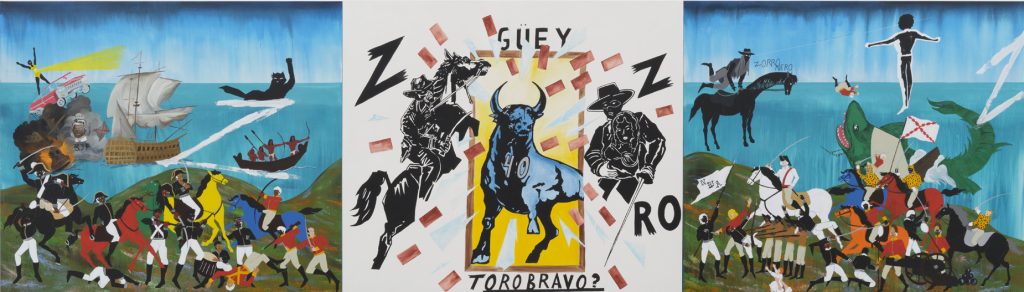
The Battle of Long Beach. Or, Z is for Zorro, the protector. Z is for zilch. Zorro vs the Starman and the old king dies. Tip a 40 in the memory of him. Feel the thiZZ. Ride that somber wave. The quick, black, fox., 2024
Tell us a little bit more about how your work has evolved over your career.
I used to work in sales; to sell an object or to sell an idea is very similar [to being an artist]. I don’t compromise my integrity to tell my stories, because they need to be told in a direct way. But oftentimes, in order to get people to understand your work, you must also see who they are, so you always need to connect with your audience.
In the way my work’s changed stylistically, it’s evolved from being very simple to more detailed; from less colourful to more colour, because sometimes to have a dynamic presentation is better. I try to make things for everyone without losing integrity. I love what I’m doing as well.
The story evolved from first talking about colonialism, racial identity, gender politics, wars, and all of these things, into more of a story about humanity. For a while, I went off into some stories about space – which I’m still continuing – but the people kind of got lost there, so maybe that’s purely for me; during the pandemic I watched a lot of science fiction television.
I expect my work to always change, it never stays the same.
"I think that art has always been important, from cave paintings through to whatever’s happening now... I think it’s a testament to humanity. "
In your submitted work, you explore the idea of alternate timelines of history and alternate versions of history, specifically looking at marginalised histories and how we can think about alternative versions of history. What drives that approach and what do you hope the audience can take from that?
I alternate history because a lot of it is usually controlled by politics. I remember when Project Gutenberg [a volunteer effort to digitize and archive cultural works, as well as to encourage the creation and distribution of eBooks] happened and then, the internet came along. We now have more access to the literature of the times. There are all these different alternate versions of history, from stories that have been suppressed or outright banned, that have made their way into various groupings of libraries. We can see the prevailing narrative and also look at the alternative narratives that existed. They didn’t emerge in the sense that I’ve created an alternate universe – these alternative narratives were always there.
I don’t really stray too far from the prescribed history that we know, but I include some of the newer things I’ve learned along the way. And that’s to make history not look so much like a monolith. We’re human beings, we’re doomed to repeat history because it’s everyone’s least favourite subject.
I try to expand people’s minds. Interestingly enough, now there’s a lot of false history that gets put on social media, and everybody goes to that. They’re talking about things they have absolutely no knowledge about because you have to study the canon first, and then you move on into the actual histories that were recorded.
For instance, there’s François Le Vaillant. He was a French historian, painter and writer who went to Cape Town, and his stories are totally different from the prescribed narrative for that place. He went and talked to the people there, and then later in the 19th century, you have German Princes roaming the Wild West in America. There are always going to be alternative histories, you just have to find them.
But what I do is combine them all to make a trinity: past, present, and future all condensed into one space. And that is accurate – historically accurate.
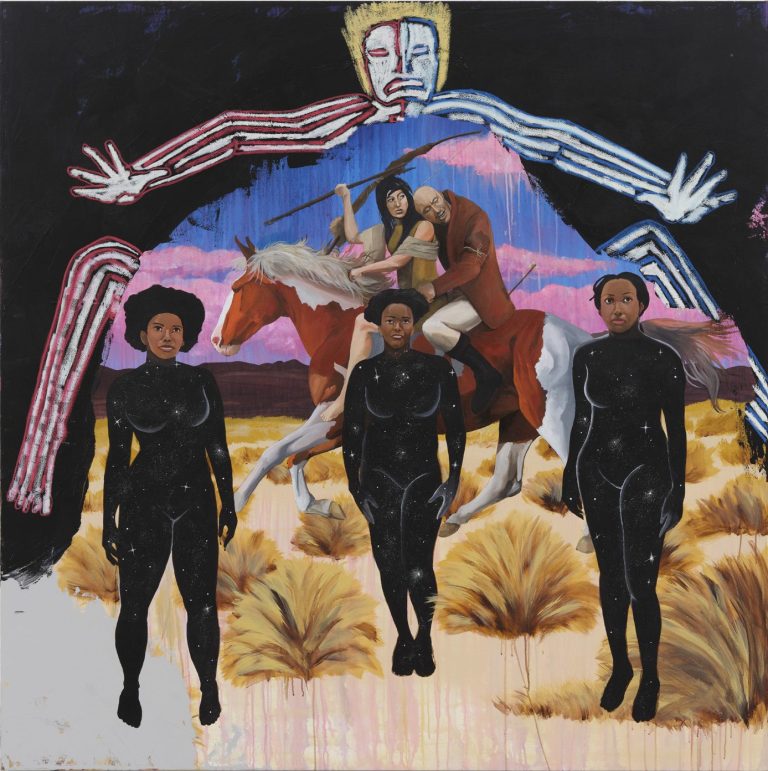
Clothes, Lachesis, Atropos. The Mojave Interdiction., 2024
You have described your creative process as ‘six months of research followed by six months of execution.’ Could you talk us through this process?
I do the research so that I’m accurate in the historical canon of these particular places, but I also let them know that I’ve modified some things – well, sometimes quite a bit – but I don’t want to insult anyone. It is not my intention to upset anyone about their history or culture.
And then there’s the six months of execution, which is actually the physical work, because I move like a tortoise. I am a very slow and methodical person until I realise that I have two weeks to complete the work, and then I move quickly, like a porpoise, or an orca with determination…or possibly a cheetah.
And then I make all the work. It’s nice to always allow yourself time to get it right, so I’m not out here spewing disinformation, because disinformation is even more harmful than a prescribed historical narrative. I let people know that it’s fiction, but it’s also rooted in actual historical terms – the history of colonialism, which is what I’m working on.
You do the research, then you do the ideas. Then you put it down on paper, a canvas, a sculpture, whatever – and you get it moving. And that way, it works for me.
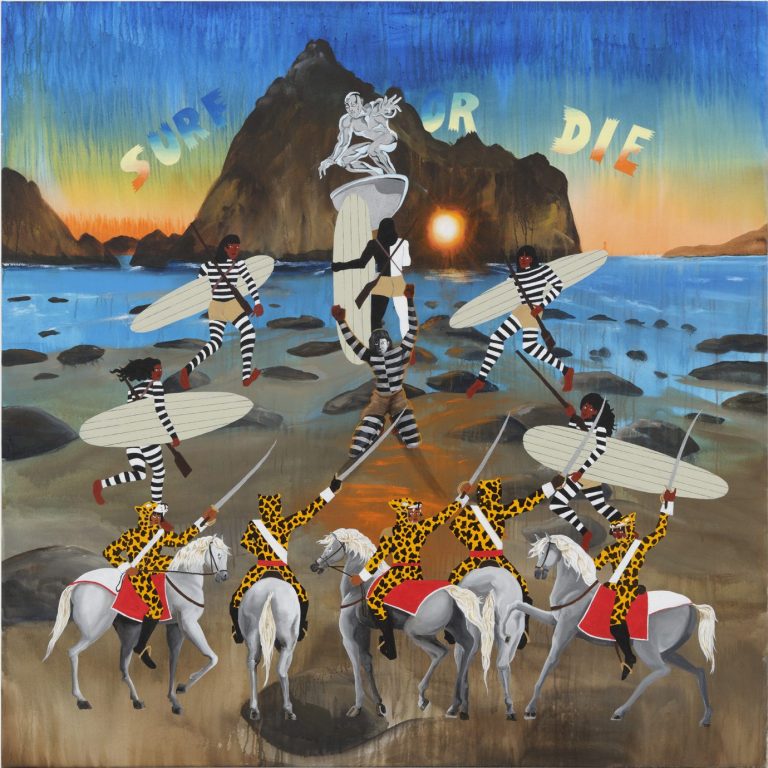
Surf or Die. Or, a silent prayer for the sun to burn our pursuer’s eyes out and lead us to safety beyond the rocky shore. A sacrifice is made. Vengeance to follow., 2024
You’ve just won the AMA Artist Award, congratulations! Could you tell us why you think international opportunities like this are important for artists?
I think international opportunities are very important for artists because you’re not stuck talking to the same people. I remember my mother had a saying: “Stop, you’re kicking a dead horse”. I know that’s a bit morbid. However, it makes a lot of sense. If you’re stuck in a particular geopolitical space – the world is getting smaller, and therefore there is more access. However, I think just the physical ability to travel from one space to another and embrace a different culture not only helps you learn more about what it is that you’re doing, but it helps you to understand and to grow greater ideas in the future. And so, I do believe that international travel is good if you can make it. If you can’t travel, you can always read a book or look at National Geographic.
I believe it’s necessary for people to travel internationally because people, the systems of whatever – banking and living – might all kind of remain the same. But it’s interesting to see other cultures; cultures are what really make the world thrive, in addition to imagination.